
Chasing down a dream—year by year
April 27, 2026
Grit, Grace, and Glory—Year One: The First in a Four-Part Journey Through Veterinary School
From the first wide-eyed days of anatomy labs and self-doubt to the moment concepts click and confidence is forged in clinics, the veterinary school experience is a progression marked by discovery, resilience, and an ever-deepening sense of purpose. It is a calling tested by long nights, steep learning curves, and real-world responsibility. Through the experiences of four students at different stages, we trace the evolution of a future veterinarian: We lead with the newcomer just beginning to find footing.
Blayne Blake, Year 1
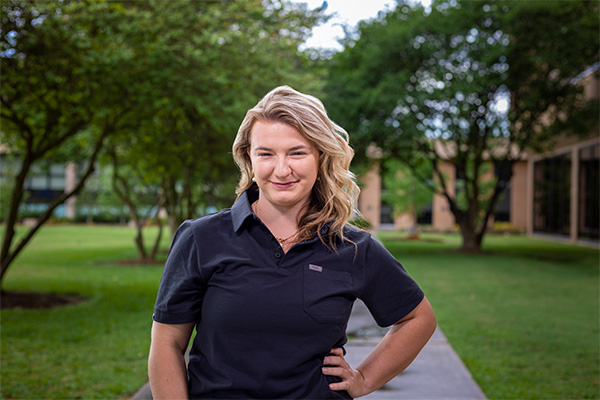
Blayne Blake, first-year veterinary student at LSU Vet Med.
Blayne has wanted to be a veterinarian for as long as she can remember. “I always knew,” she said. Now she is pursuing that dream alongside her mother, who is a first-year veterinary student at Kansas State University College of Veterinary Medicine. The two went through undergraduate school together at the University of South Alabama and made the decision to apply to veterinary school at the same time.
“I originally thought I’d transfer to my mom’s school, but I really like it here at LSU!” she said.
She remembers the moment she was accepted to LSU Vet Med. “It was a Friday night. I was in the barn when I saw on my phone I got an email. I got my laptop and sat on the bed with my mom and twin siblings. Accepted! I was in shock for an hour,” she said.
Her advice for admitted students is to enjoy their summer before vet school, don’t panic about stress, and start reviewing the anatomy of dogs. “You’ll hear that it’s hard. Don’t put that in your mind,” she said.
Blayne grew up on a farm near Mobile, Ala., first with horses, then dairy goats that her family bred, and she showed throughout the U.S. She helped milk goats morning and night, pulling 70-90 baby goats during springtime, and helping to bottle feed them. “Our veterinarians always made sure we were involved in our animals’ vet care,” Blayne said.
After graduation, Blayne plans to go to work as a large animal veterinarian. “People need to understand why they want to pursue this work. It takes grit,” she said.
Here at LSU Vet Med, most days begin with morning lectures on various topics—form and function, evidence-based veterinary medicine, professional development—followed by anatomy lab, clinical skills, immunology, and communication skills. Comparing notes with her mother, Blayne has found LSU’s curriculum both intense and deeply meaningful.
Despite the workload, she has found a strong sense of community among her classmates, whom she describes as friendly and inclusive. Her biggest personal challenge has been being away from her family for the first time, but she has built a support system—cooking with friends and spending time with her cat, Quinn.
Blayne recently completed her first externship at a veterinary clinic in Kansas and is already looking ahead. After graduation, she plans to become a large animal veterinarian, with the long-term goal of opening a practice with her mother.
Reflecting on her first semester, she feels a sense of growth. “I was very nervous about expectations. I have had bad days, but it has been manageable,” she said. “Overall, I feel a sense of accomplishment.”